Many Minds
Many Minds is a place to think with minds unlike your own. The user brings a belief, and a room of AI characters, each with their own discipline, history and way of seeing, pushes, reframes and reveals what the user cannot see alone.
- Role
- Independent developer
- Timeline
- 2026, in development
- Built with
- Three.js, DeepSeek V4, Jev, Tavily
- Links
- many-minds.net ↗
Private alpha. Be an early tester
I often sound sure of myself while missing my own gaps, and today’s feeds and chat assistants make that certainty stronger.
My moments of real inspiration and critical thinking came from talking with someone smart and unexpected, a person whose work or life made them see my question differently. Those moments were rare luck. In ten one-hour interviews I ran, nine people described the same thing: their last real blind spot came from a conversation with another person.
Most tools work in the opposite direction. Social media feeds are designed to show users what they already believe. Chat assistants such as ChatGPT and Claude accept the user’s framing and return one balanced answer, which treats a narrow debate as clear thinking. Many Minds is my attempt to make that unexpected conversation something users can walk into. Its aim is to give people the thinking they could not have reached alone, not answers.
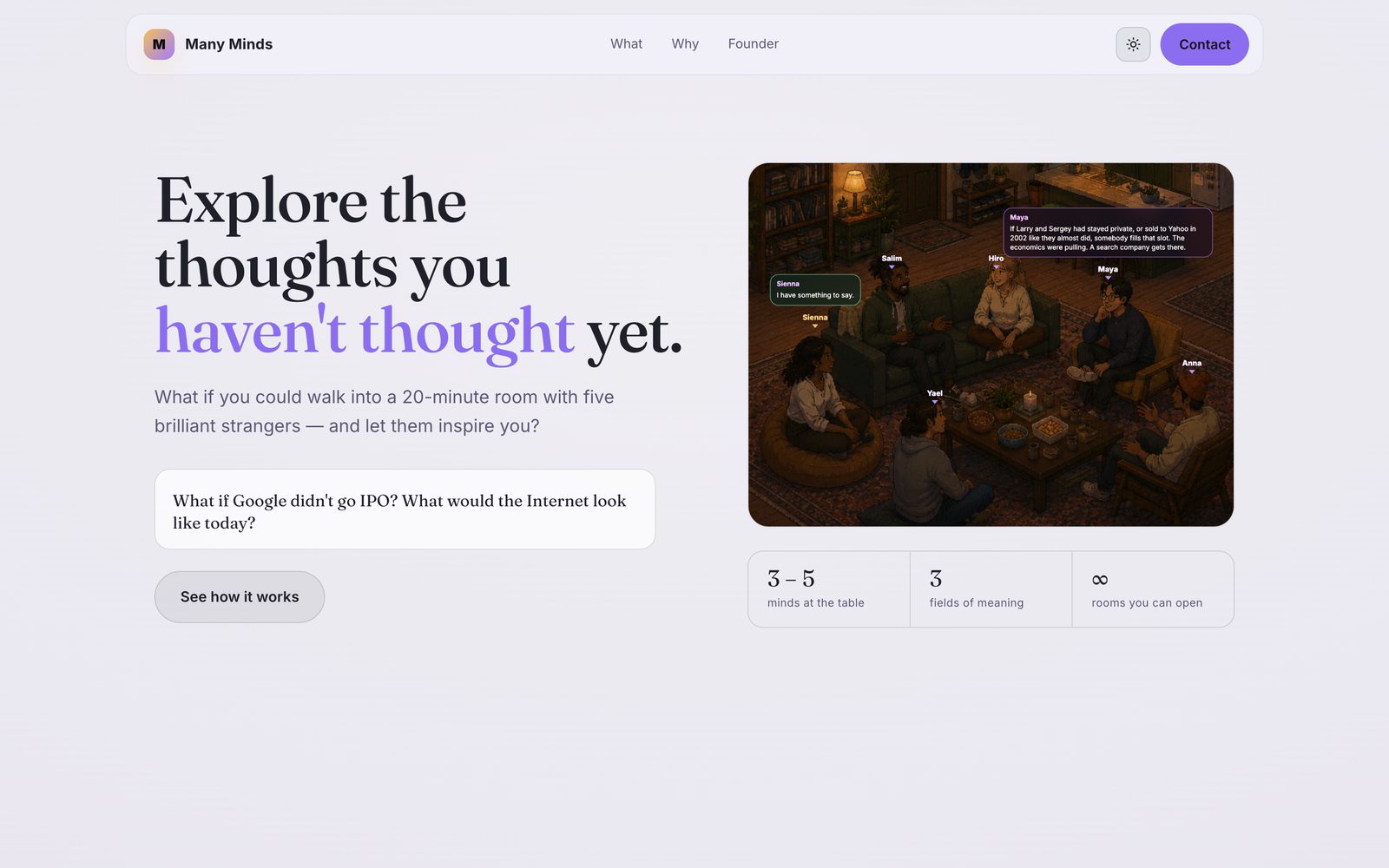
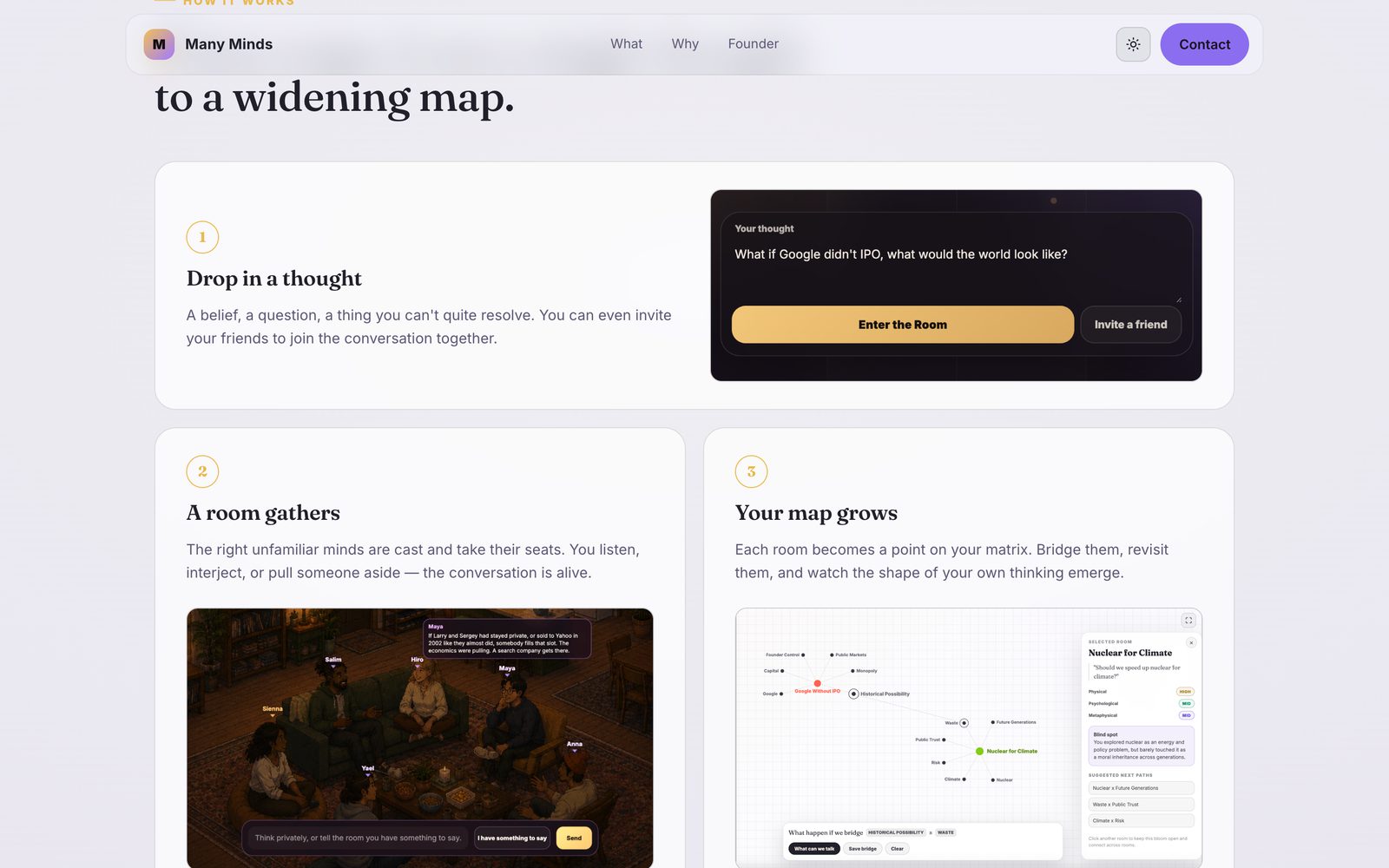
A belief opens a room, where characters cast for productive disagreement discuss it with the user.
The user types a belief, a question or something they cannot resolve, such as “What if Google didn’t go IPO?” A character composer reads it and casts four characters for productive friction, the people most likely to disagree in a way that opens something. Each character has a discipline, a school of thought it defends, a scale it habitually looks at, from one person to a whole society, and a life, so arguments arrive as specific cases rather than general opinions.
The user can listen, speak, raise a hand, call a break or pull one character aside to talk privately. The room also turns to the user at most twice, with a small question only the user can answer, such as a habit or a scene from their own life.
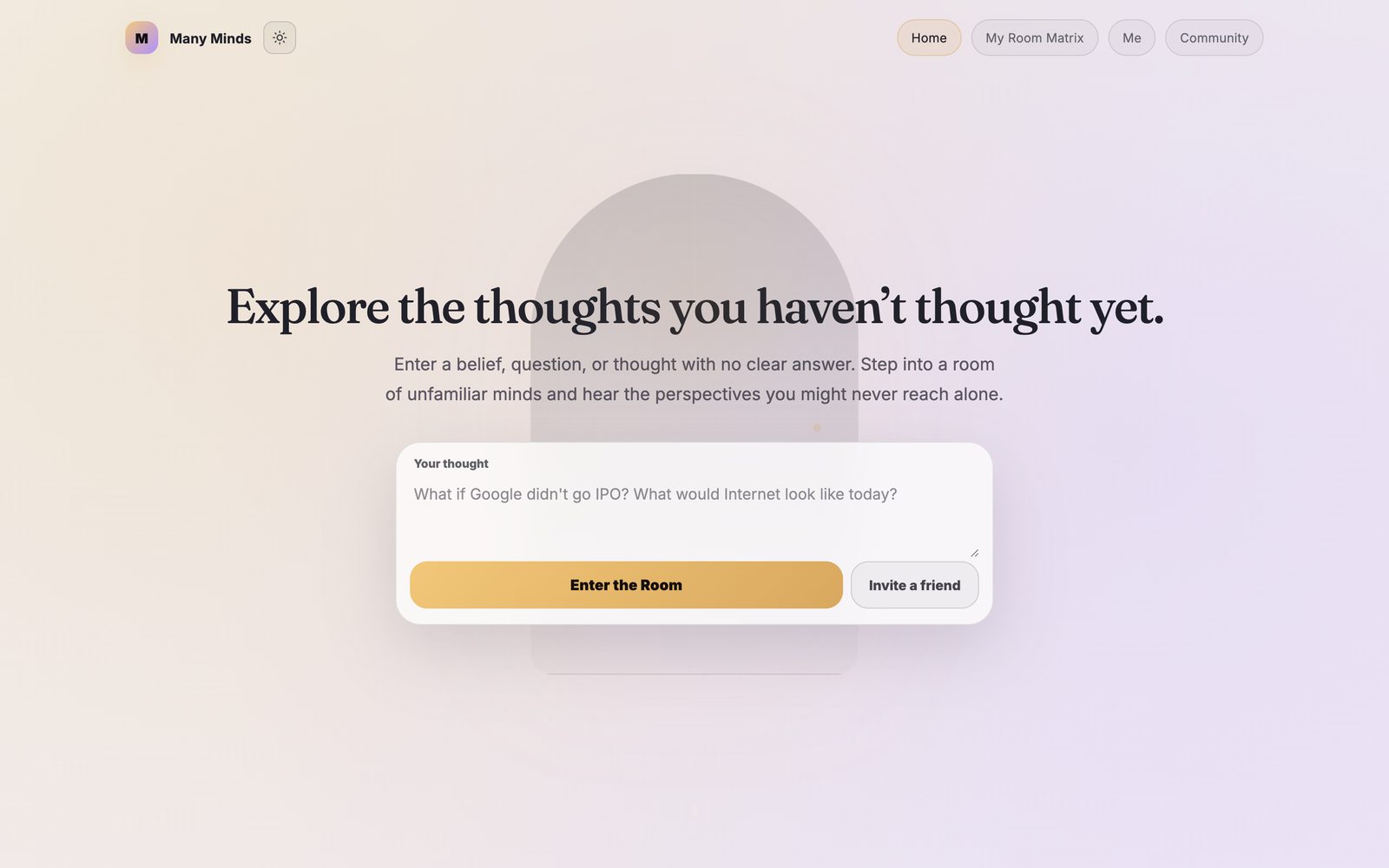
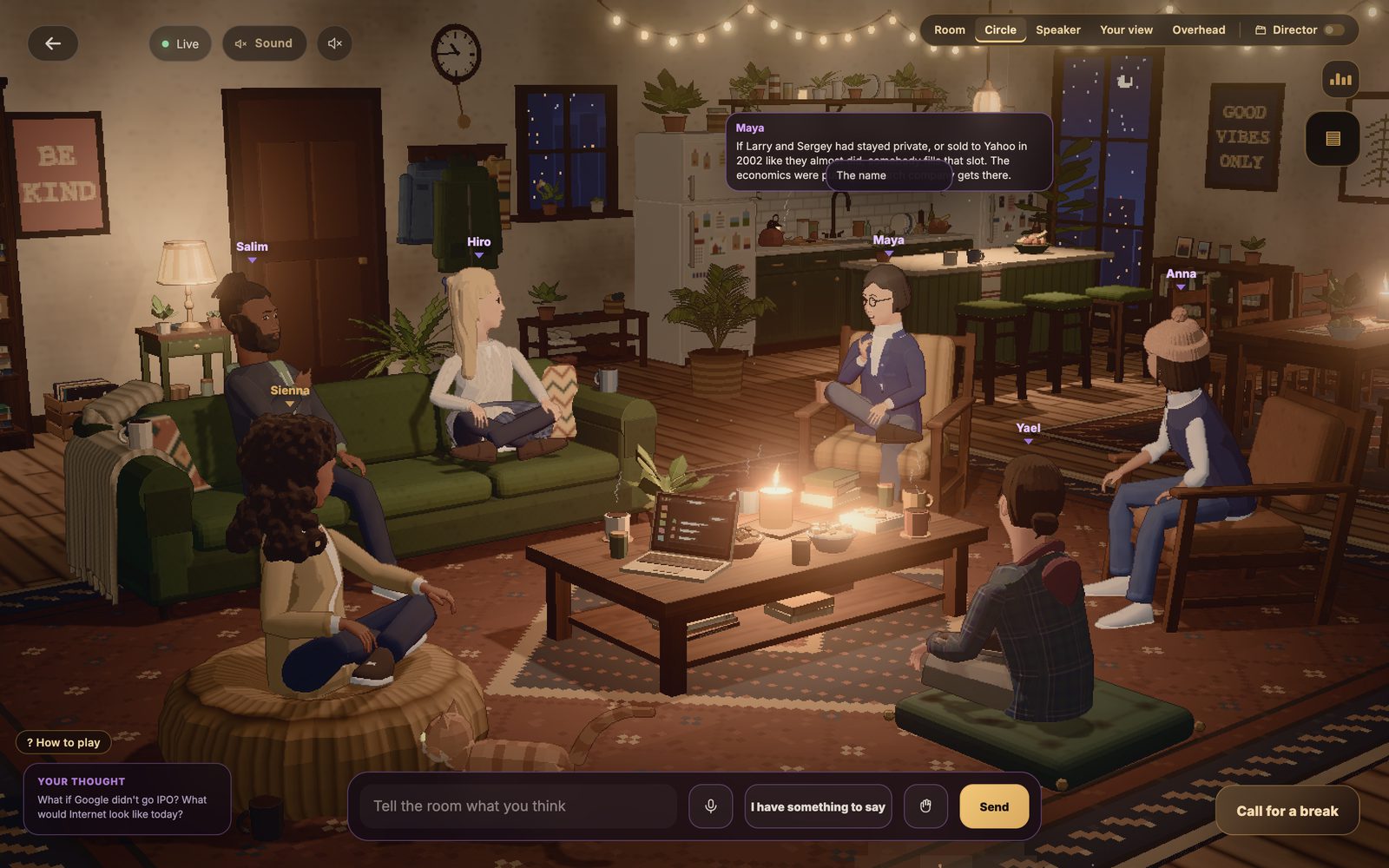
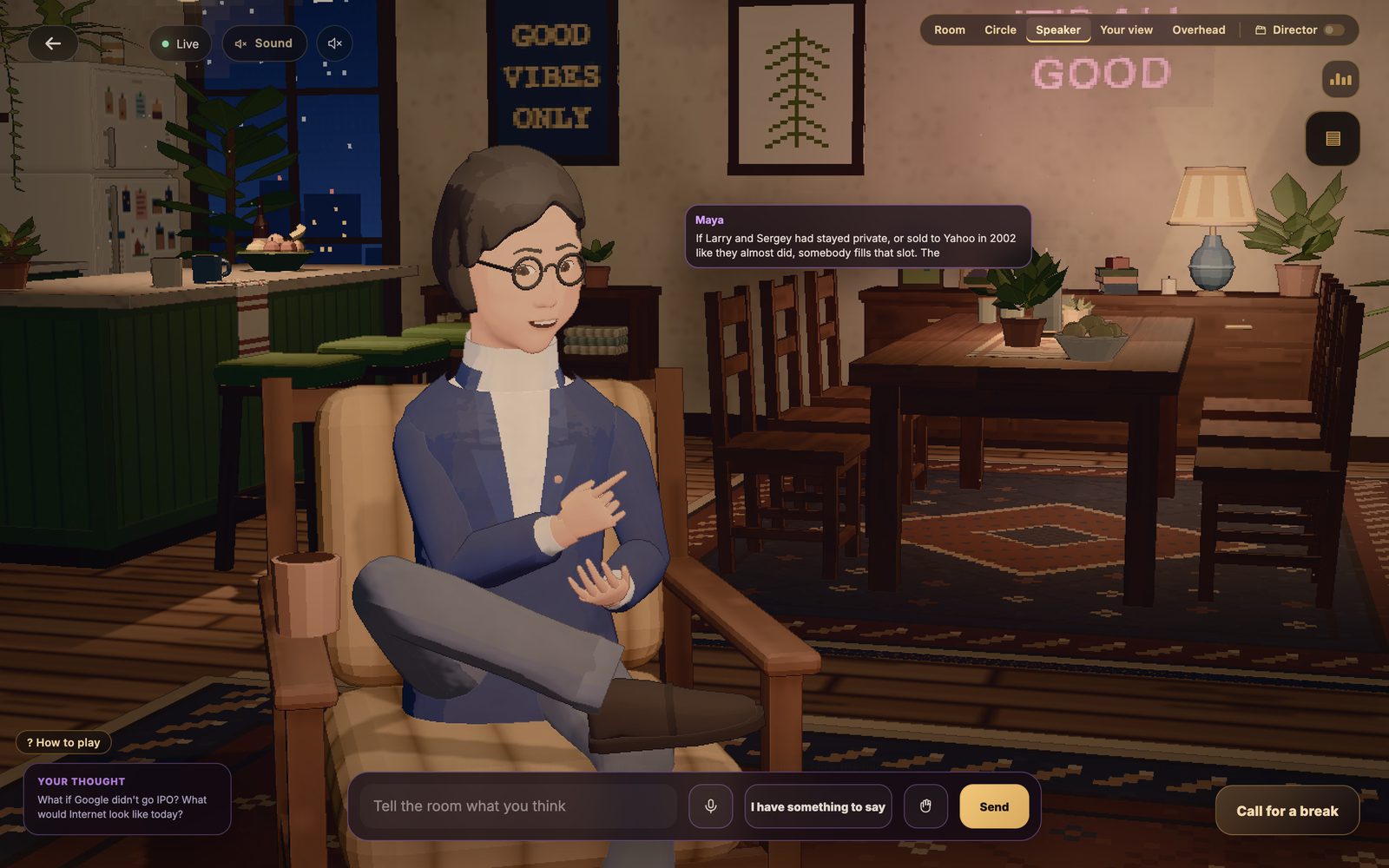
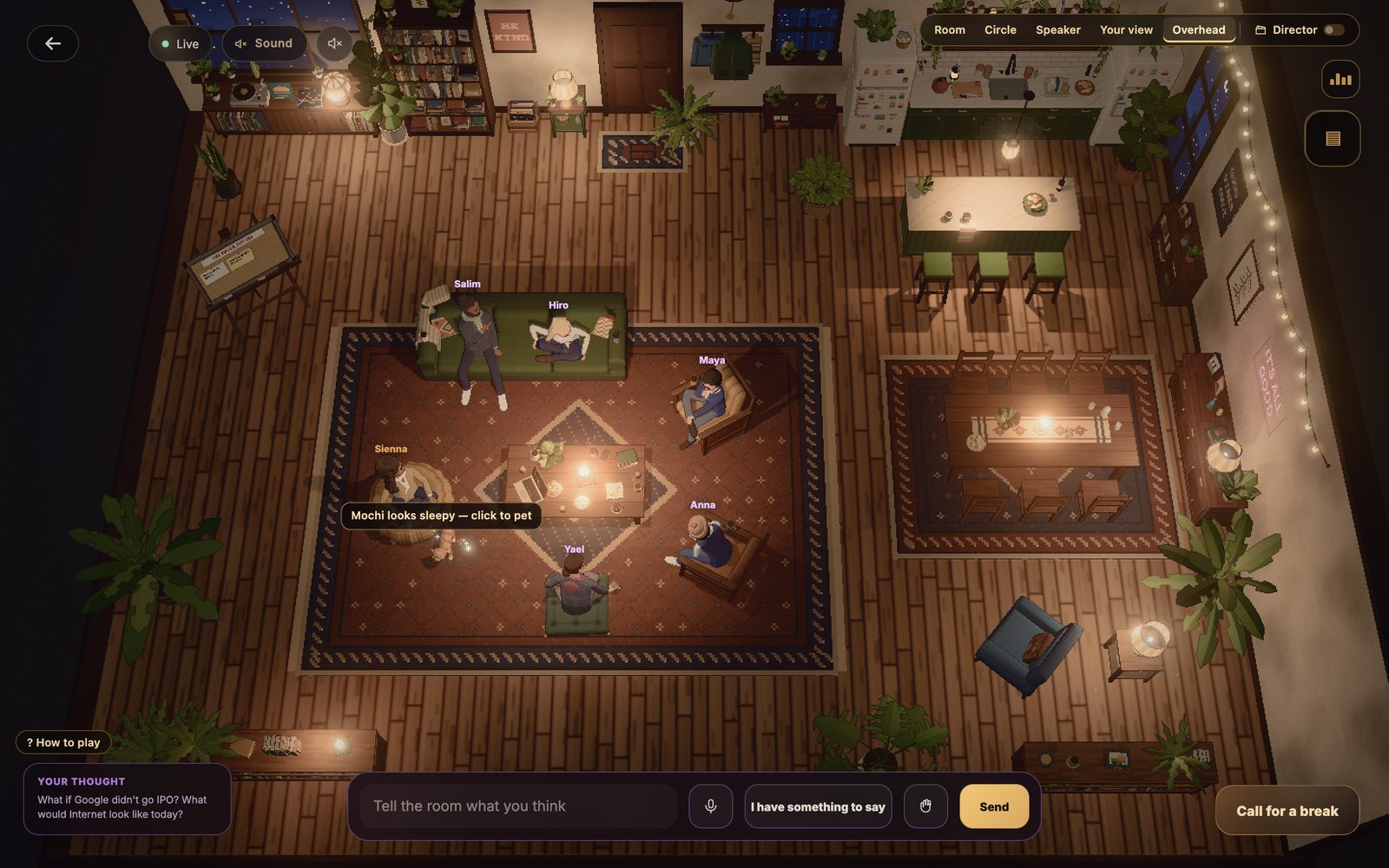
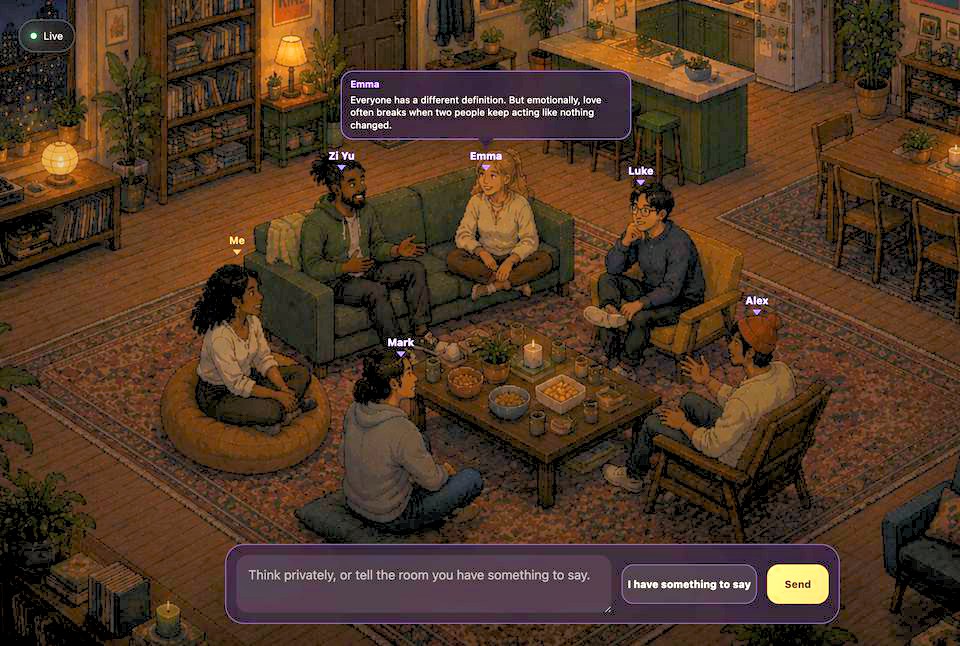
The first prototypes were 2D illustrated rooms, where the cast took their seats in a setting the user chose.
Before the 3D room, each prototype was a single illustrated scene, such as a living room with a library or a picnic on the grass. The characters sat in a circle with the user’s own seat marked “Me”, and the conversation appeared as speech bubbles above whoever was speaking. These scenes set the warm, small-group feeling that the 3D room keeps today.

A review of the first engine found that it produced positions instead of people, so I rebuilt it around people and real material.
The first engine assigned each character a stance and each line a task before anyone spoke. In 35 generated conversations, 32 contained no character with a life of their own, none of the 303 lines reacted to the line before it, and no one ever turned to the user.
The current engine prepares before the room opens. It finds eight to ten real and surprising cases for the question, checks each fact with web search, and casts at least two people who live with the question and one who believes the common answer. During the room, the next lines are decided only after the previous ones have been heard.
Before casting, the room maps which intellectual traditions the question needs, so that critical perspectives are not left out.
An early room on why young people are less willing to marry included no feminist perspective, because the library of frameworks it drew from did not contain one. The room now starts with a perspective map. A model checks the disciplines and critical traditions a question touches, including gender, class, race and colonialism, the state and non-Western thought, and keeps the five to seven most central.
A library of 240 frameworks, each with its author, year, blind spots and known critics, is used only to verify what the characters cite. When one character applies a framework, another can point out what that framework cannot see. A scholar who cannot be verified is never named.
A small judgement model reads the room every few lines, and open-source models write what the characters say.
Jev, a judgement model from TypeSafe, answers about 35 kinds of short questions: who should reply, whether the room is going in circles, whether to turn to the user, which of two drafts is better. In the first room judged entirely by Jev, it made 978 judgements with a median time of 0.46 seconds, at a cost of $0.037 for the whole room.
Open-source models write two drafts of the next two to six lines. An editing step removes lectures, repeated cases and unsourced statistics, and a safety check stops the story and offers a helpline if a line shows signs of risk. Each line carries stage directions, including who speaks to whom, the expression, and whether a close-up is worth it, which the 3D room performs. Preparing a new question costs about $0.24. The current design adds a question gate, which rewrites a question such as “What is love?” into a claim that someone holds and that the room can test.

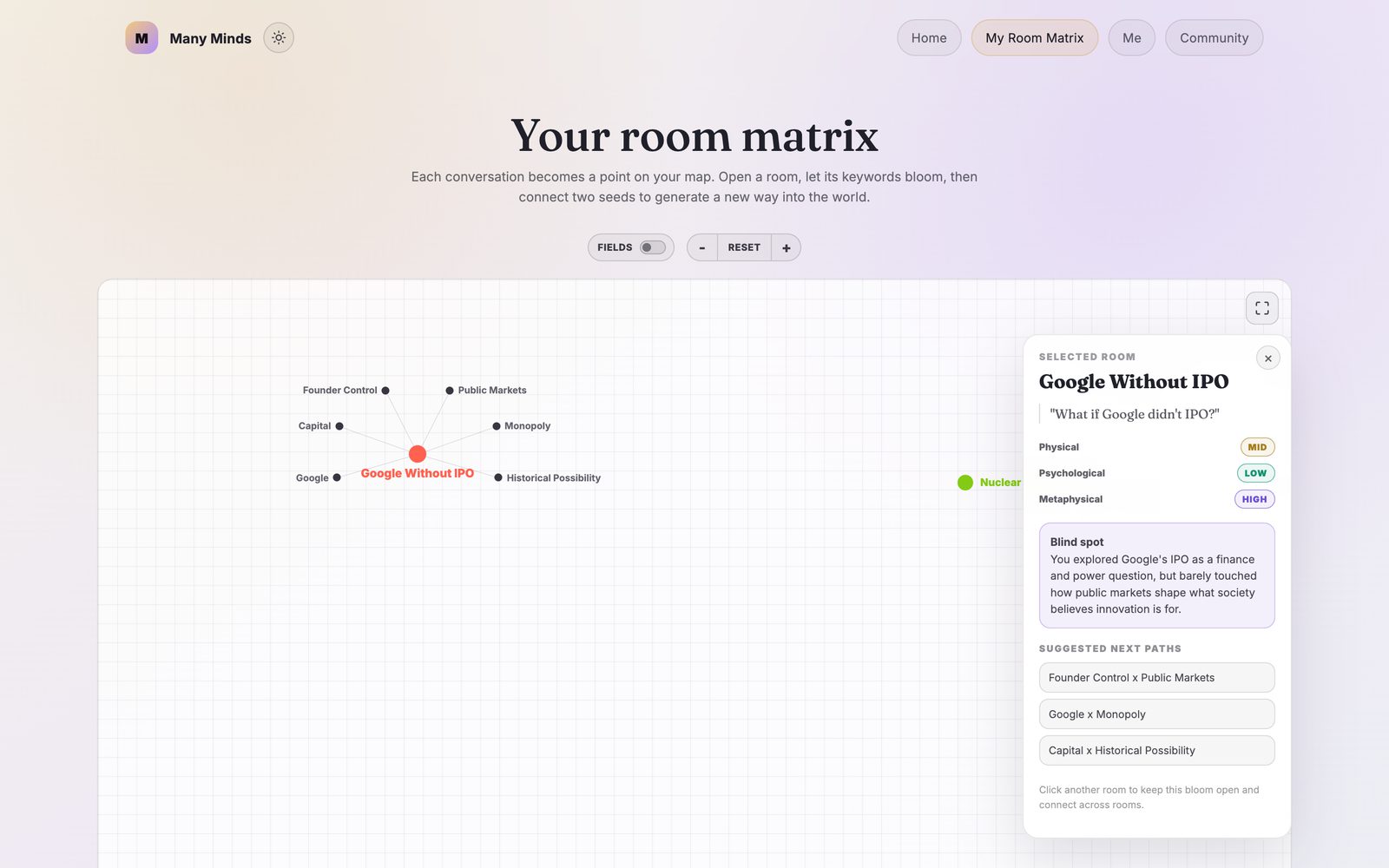
A room ends when something has moved, and each room becomes a point on the user’s own map of how they think.
A room closes only after it has turned to the user, the user has spoken twice and at least one character has changed their mind. Three characters each say a last line to someone in the room, naming where their view changed or what they still will not give up. The user keeps one of three questions, and a card records what the original question became, what moved and what remains open.
Each room then becomes a point on the Room Matrix. Opening a point lets its keywords bloom, and the Bridge Composer turns two keywords into a new question and a new room the user would not have asked on their own.