Quarter Inch
Quarter Inch is a story game in which the player is 12 cm tall and trapped in a shared apartment in Brooklyn. The only way out is to change what the roommates think, and each roommate is played by a language model.
- Role
- Independent developer
- Timeline
- Since October 2026, in development
- Built with
- Three.js, Blender, MakeHuman, DeepSeek V4.1 Flash, Jev
- Rooms
- Ray and Eli playable; June and Nadia in prototype
The player cannot fight or leave, so every puzzle is a conversation with a roommate.
Adventure games are usually solved with objects and locks. In Quarter Inch the player is 12 cm tall and weighs 22.6 grams, so the only actions are looking, pushing small objects and talking. Each roommate has a room, a reason to keep the player, and a different idea of what the player is.
Every room is modelled at real scale with real weights, so the game needs no rule to say the laptop is too heavy. Physics got there first.
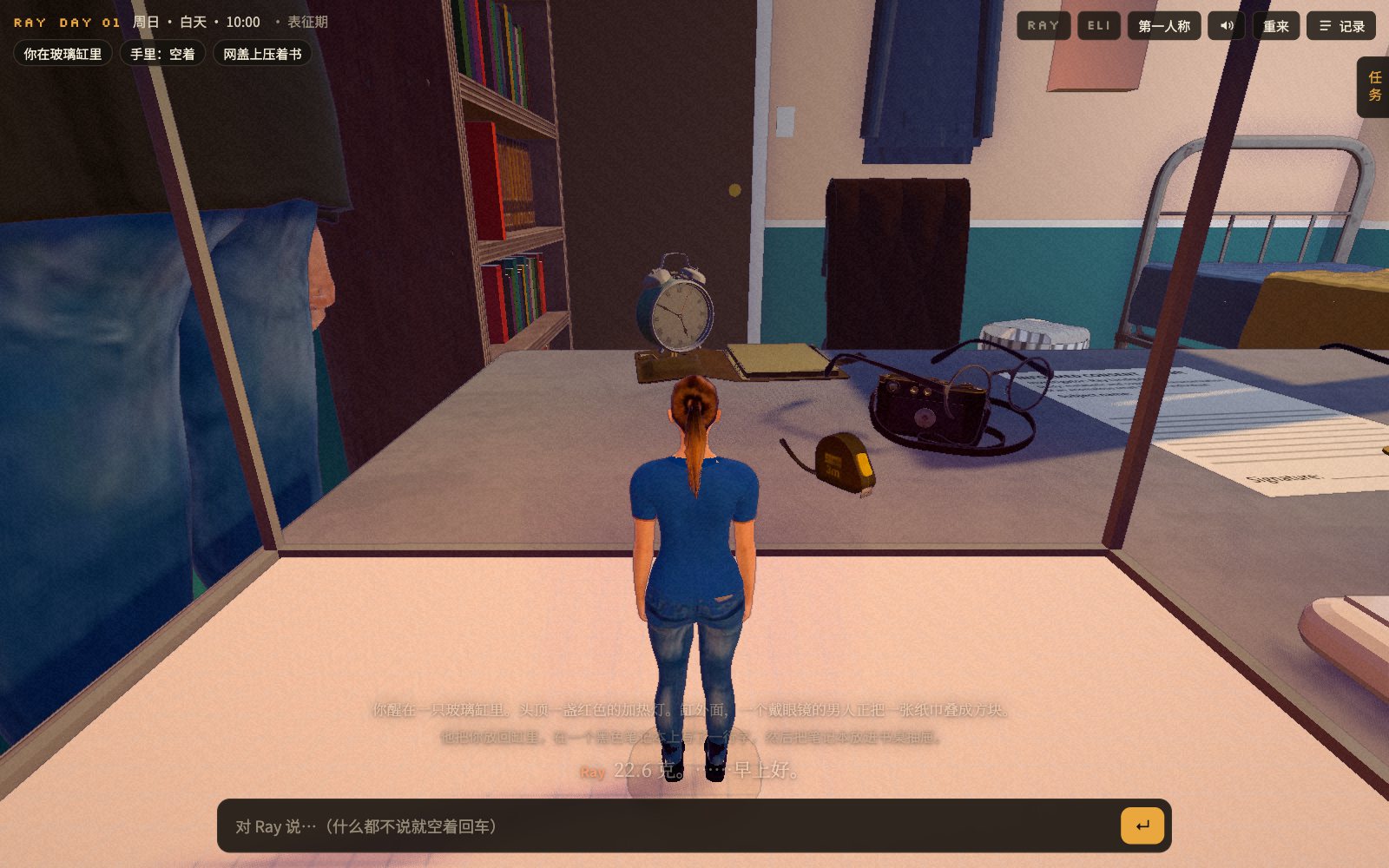
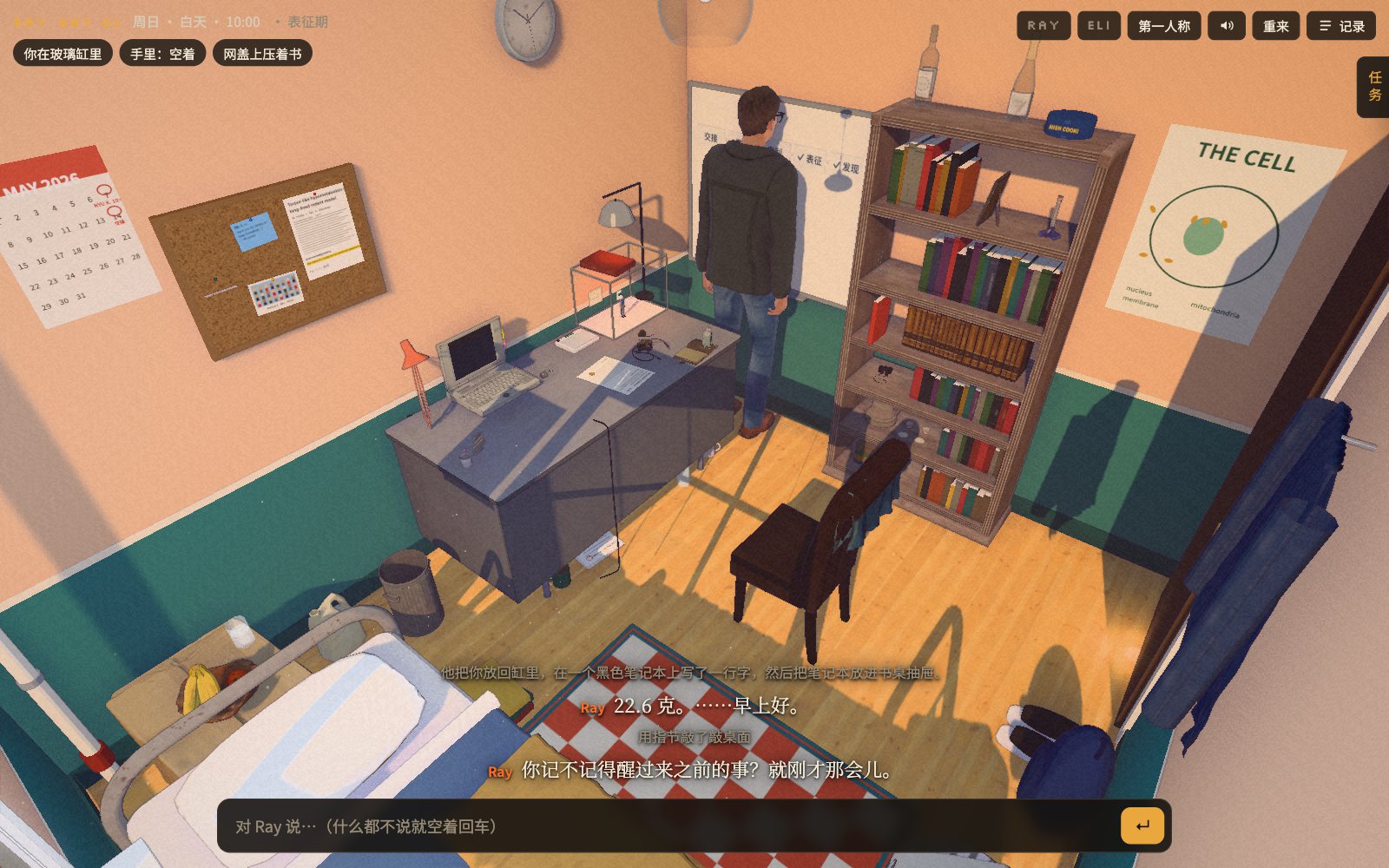
The room fills the screen, and the player acts only by clicking objects and typing in one input bar.
The first version framed the room with controls: a large dialogue panel on the right, buttons to say, do, wait or sleep, and pickers for whom the player was talking to. I removed all of them. The 3D room now fills the screen. The player clicks objects in it and types in one input bar at the bottom, and pressing Enter with nothing typed is a silent turn, in which the player looks at the roommate and says nothing.
The latest exchange appears as subtitles above the input bar and dims after 15 seconds. The conversation record, the storyline, the notebook and the designer view sit in a drawer behind an icon at the top right. The camera has a single switch between first and third person, and sound has its own icon.
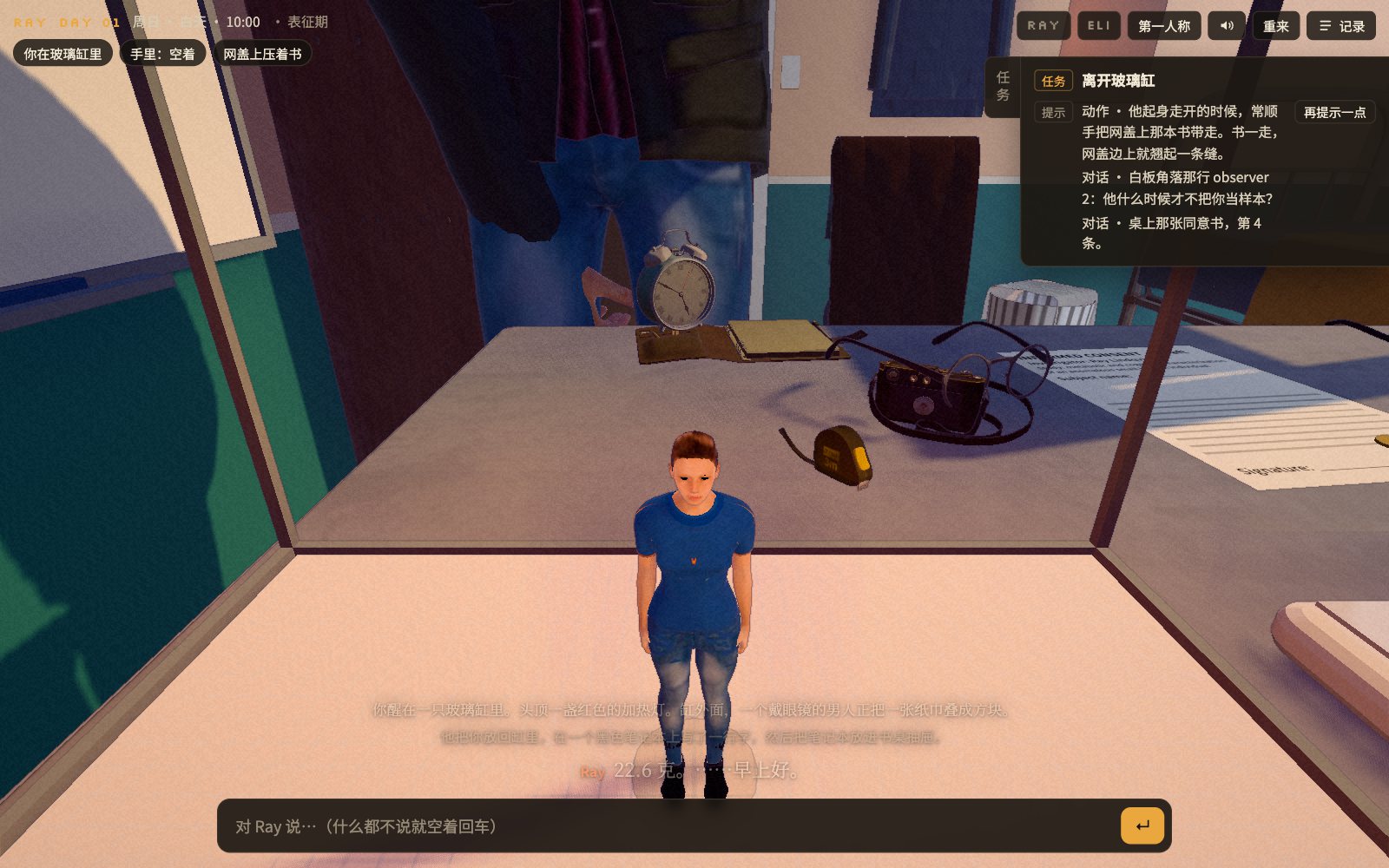
When the task changes, a task card slides in from the right edge and tucks itself away after 9 seconds. It shows only the current task. Hints appear only when the player asks for them, in three levels: first a question, then a sign in the room, then the move itself.
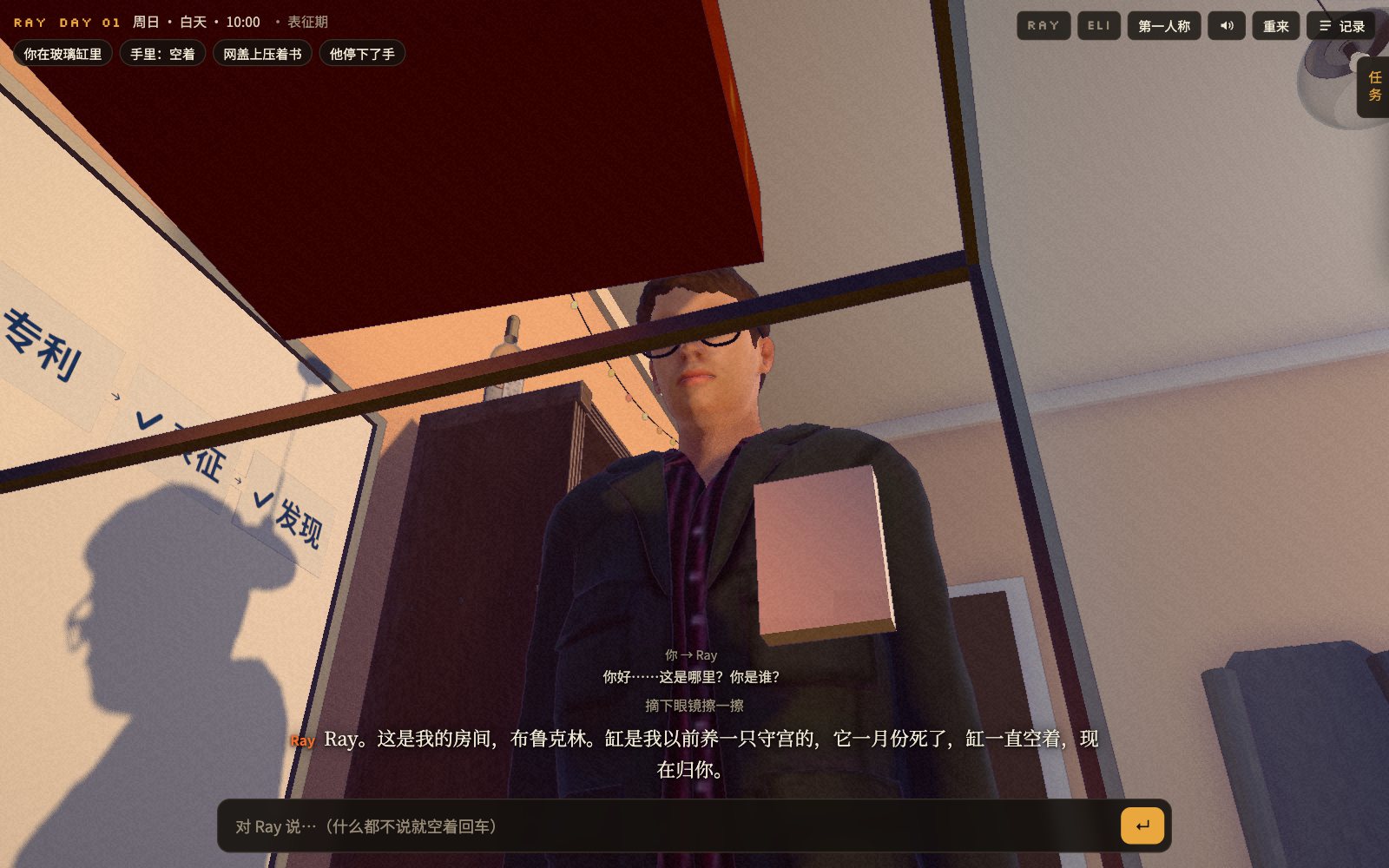
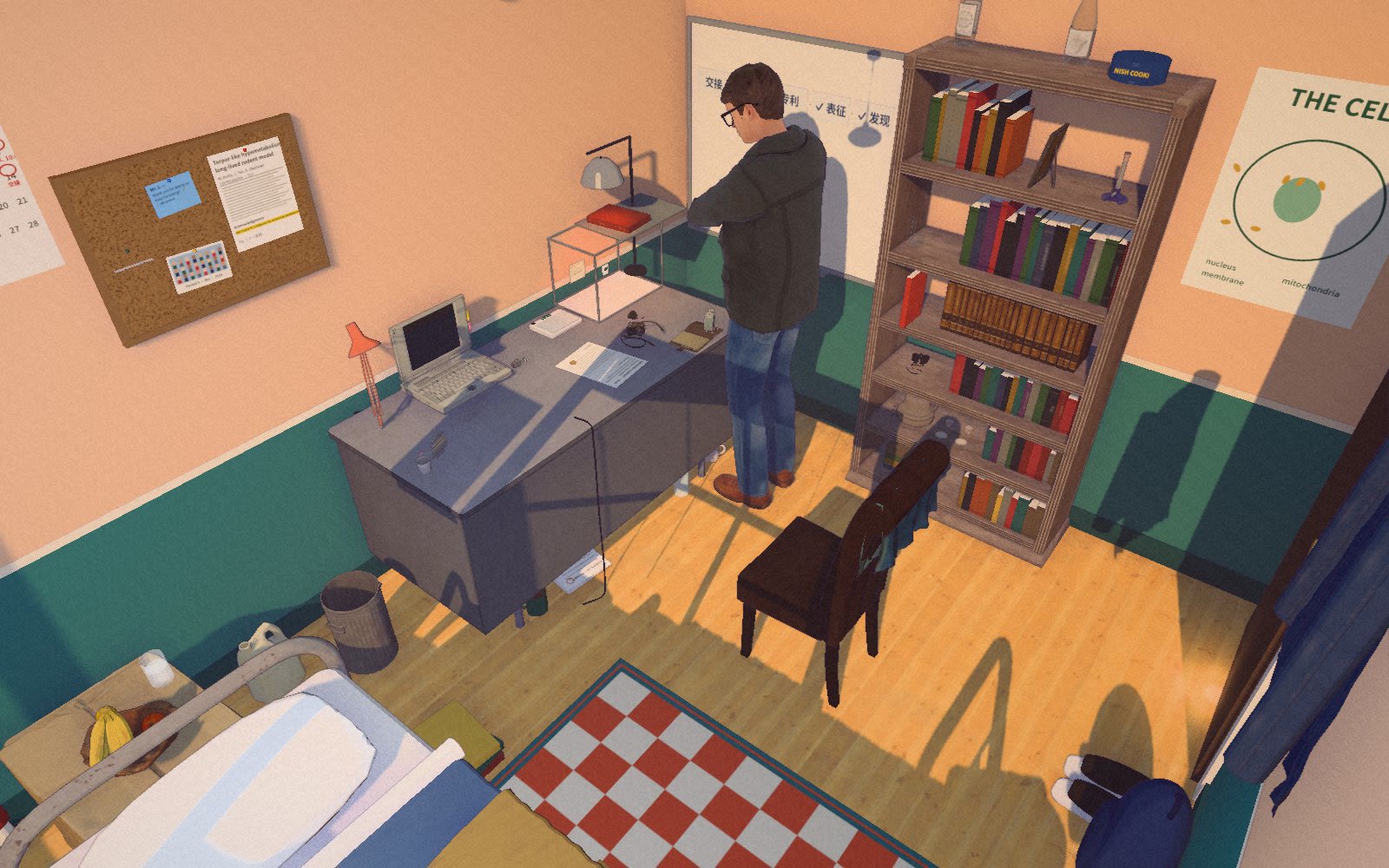
Ray is a biology teacher who wants credit for the discovery, and the money a lab is offering for it.
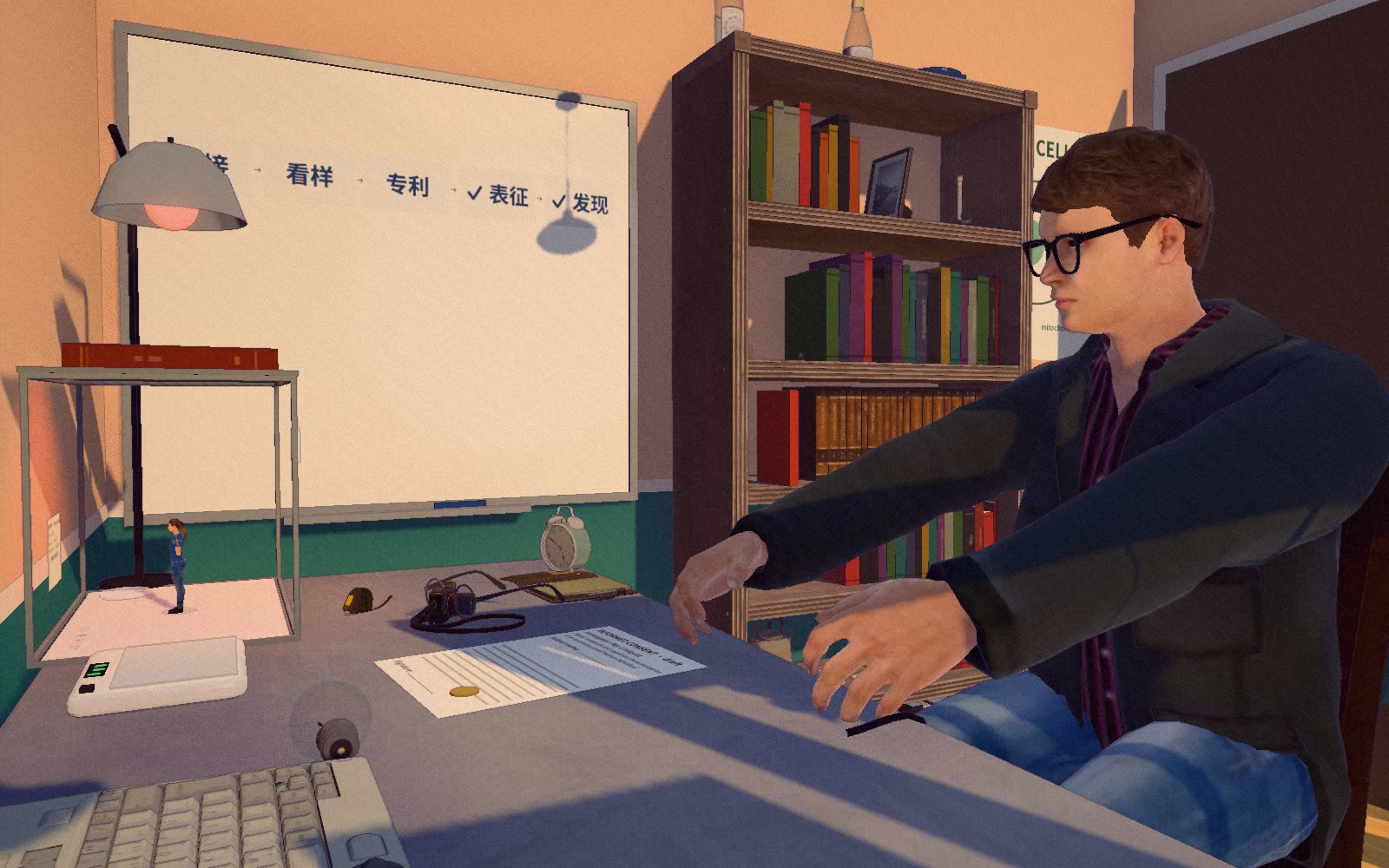
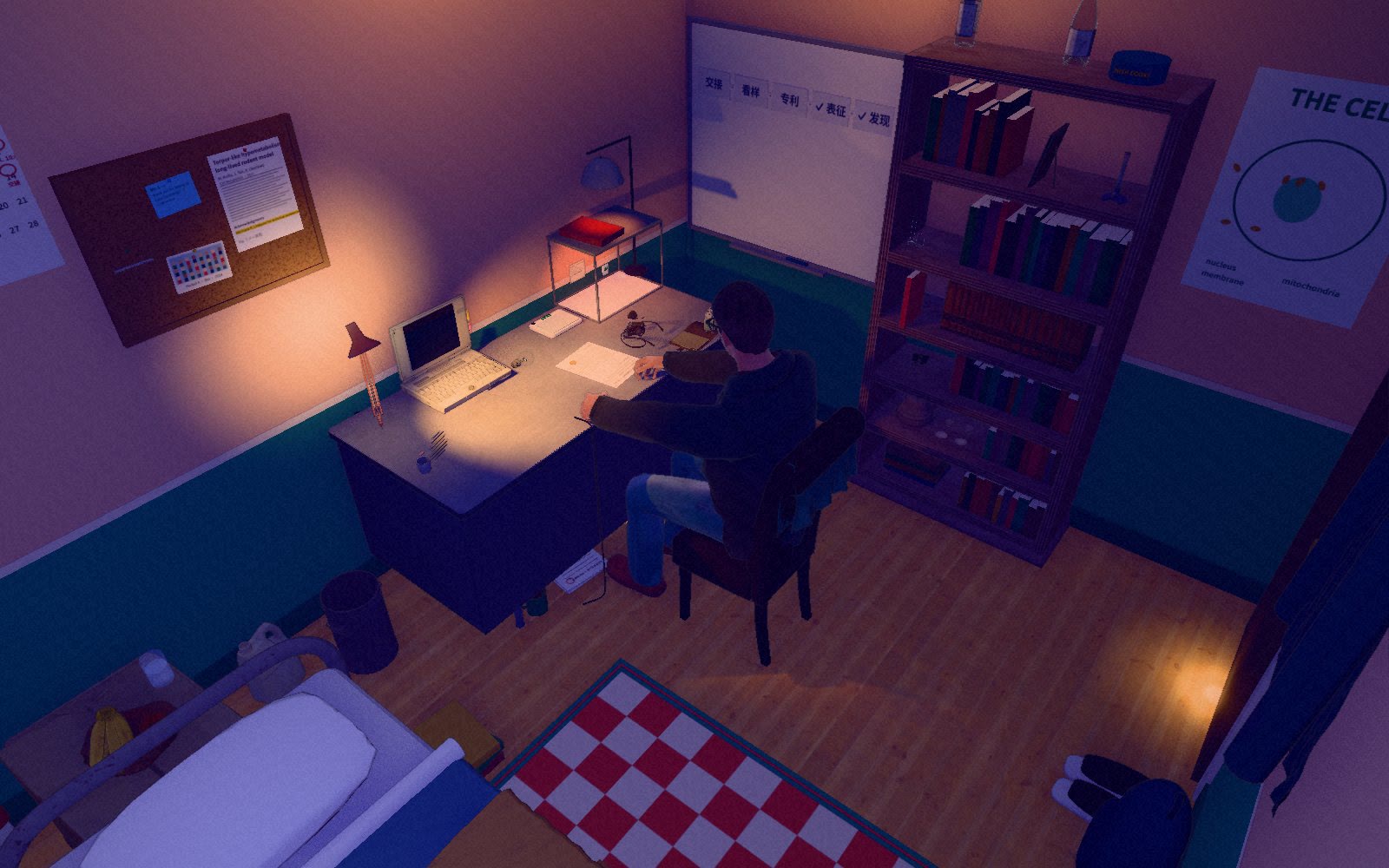
Ray is 36 and teaches high-school biology. His PhD adviser once published two years of Ray’s data and thanked him in the acknowledgments for “technical assistance”. He treats the player as a specimen, and his curiosity is the player’s main lever: he asks questions, takes measurements and keeps notes. His plan for the specimen is on the whiteboard in five steps, and two are already ticked.
Eli is a laid-off developer who has stopped talking, and the goal in his room is to get one word out of him.
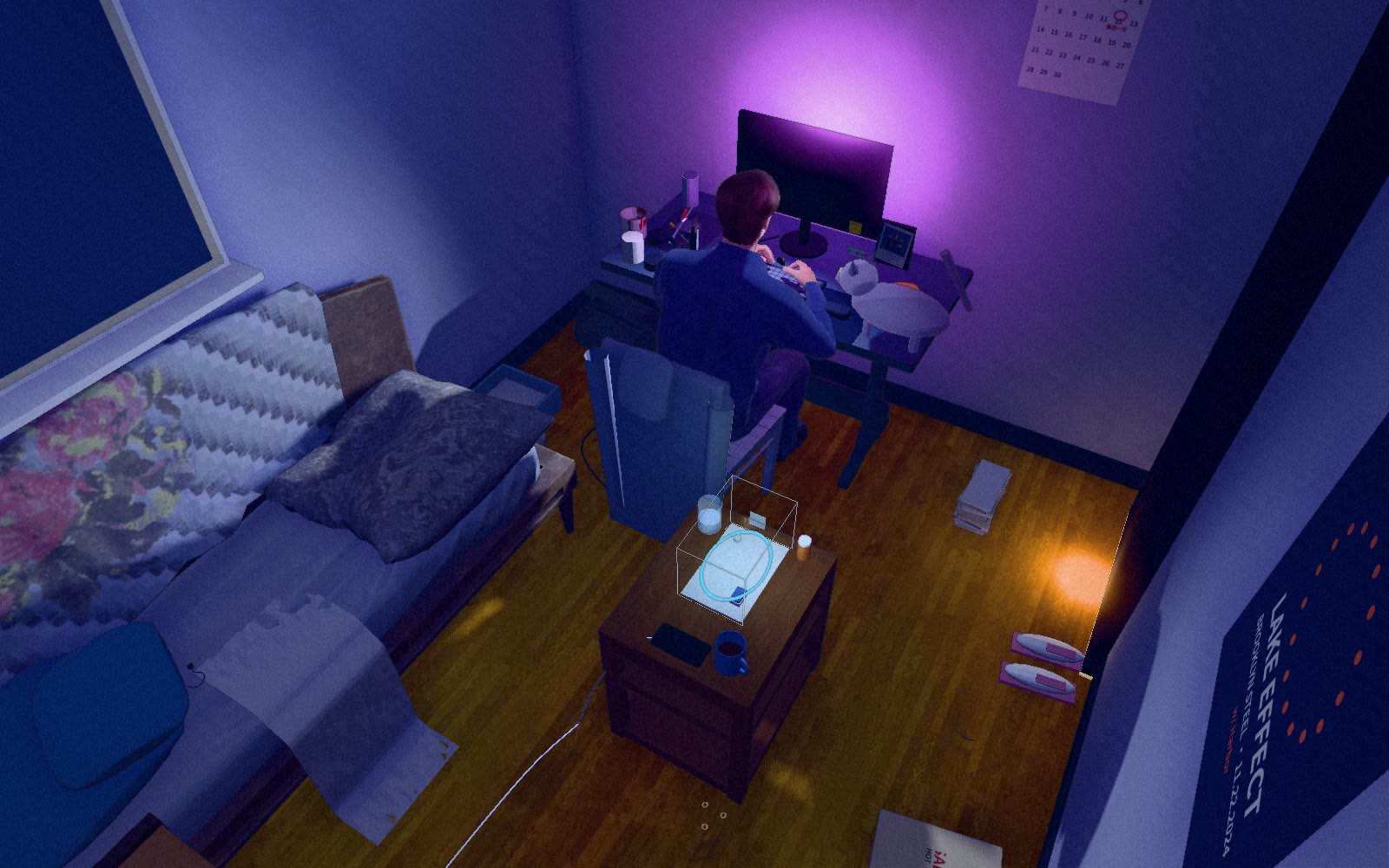
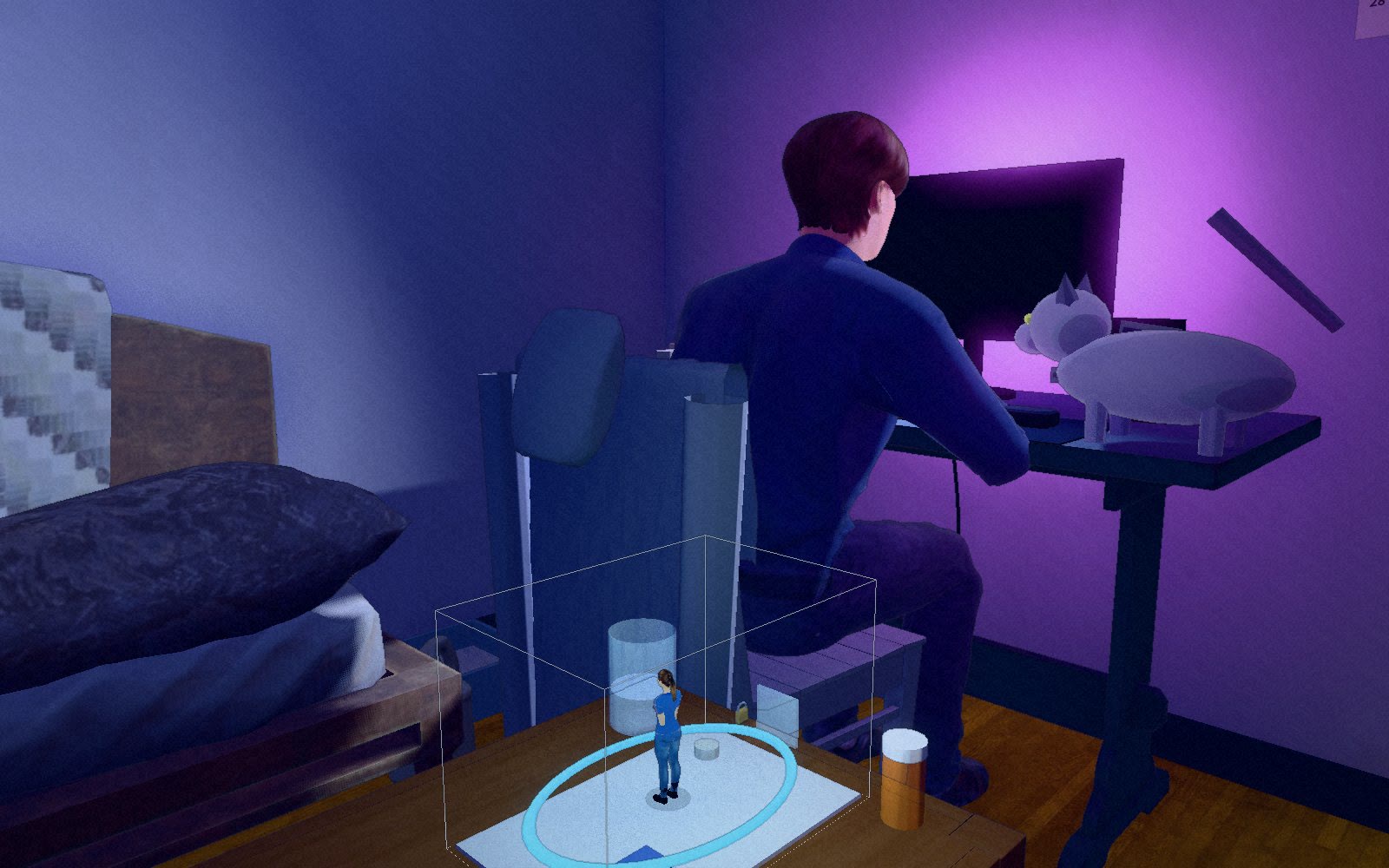
Eli is 29 and lost his job eleven months ago. He built the player’s box in one night, with LEDs, a small bed and a luggage lock, and the key has been under the box’s mattress the whole time. He watches more than he speaks, so his model is allowed to stay silent, but every silence has to show as an action, such as a glance at the box or the LEDs turned up one step. The cat has no name.
Getting him to talk to the player is a step of the story, and at first it completed by itself. The prompt told the model to stay silent or speak only to the cat, yet it answered the player directly within four turns. Now the code turns each of his lines into an aside to the cat until the player opens him up in one of five ways: asking about something he built, asking for something the player needs, such as paper and a pen, telling him about the player’s own life twice, staying silent twice, or pushing a cereal ring to the cat.
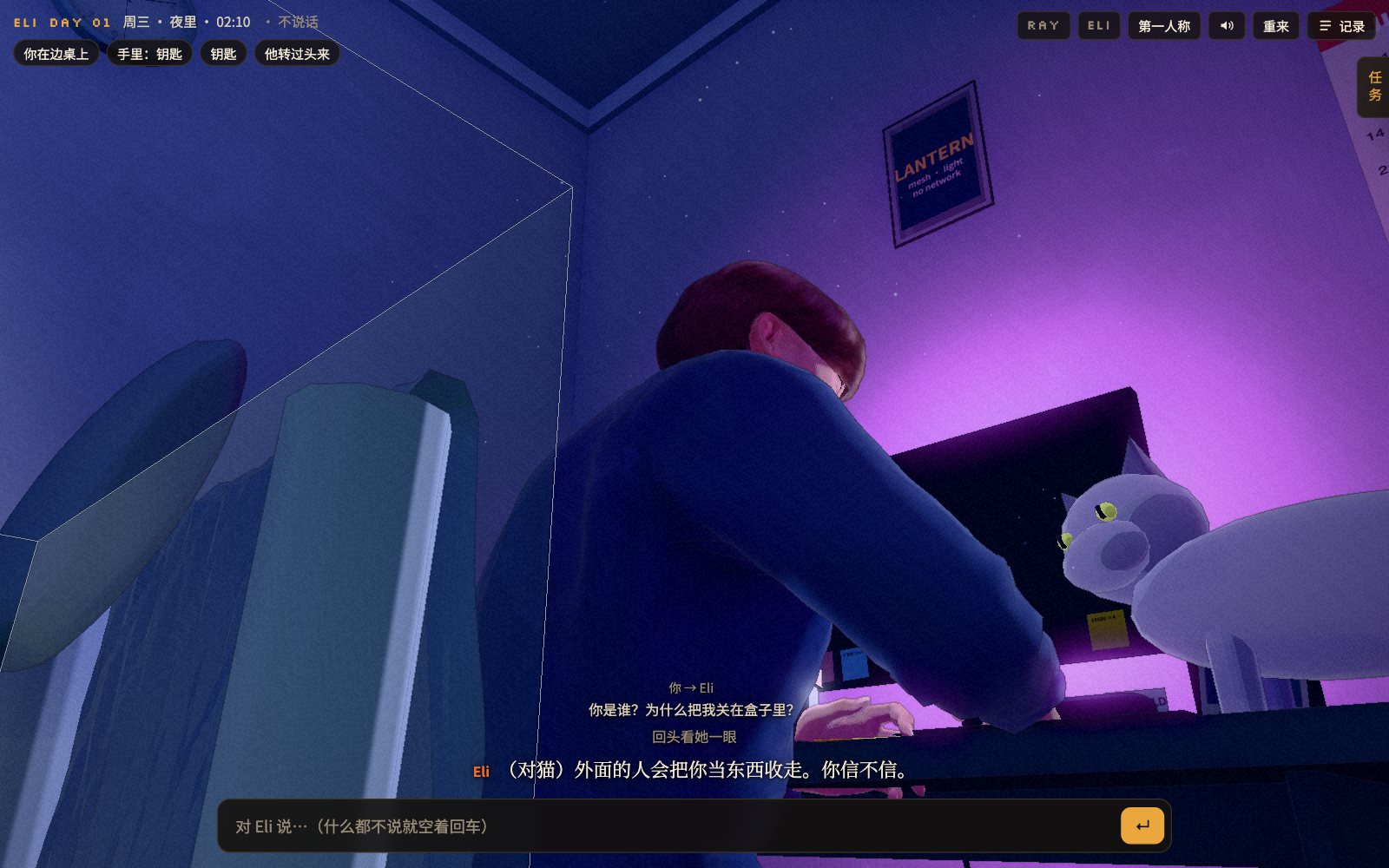
No task waits on the clock, because the room creates what the current step lacks within seconds.
Many steps used to wait on the clock. The buyer came on day 7, and Eli went down for his takeout at 03:30. The clock moved every three turns, so a player who already knew what to do could press Enter a dozen times waiting for the moment.
Each step of the story now lists chances, events the room can create for it. When the current step lacks a condition that only the room can provide, the room creates it a few seconds into a pause, for a reason of the character’s own. If the player does not use it, it comes back about 20 seconds later with a different reason. Ray takes the book off the tank’s net lid to read in the toilet, and the lid lifts a crack. The next time it is a phone call in the hallway, and then a kettle.
The other chances work the same way. Ray goes out to cook, fetch a parcel or shower when the player needs his desk drawer, and his experiments on the player begin when the current step is to make him stop calling the player “subject”. The buyer, K., knocks about 10 seconds after the player confronts Ray and stays for six turns. Eli starts a small repair, such as a stuck key or some soldering, when the player needs to help him, and lying down in the box with the key passes the night. Time follows the story as well. Finishing a step moves the clock one phase, and without progress it moves every eight turns.
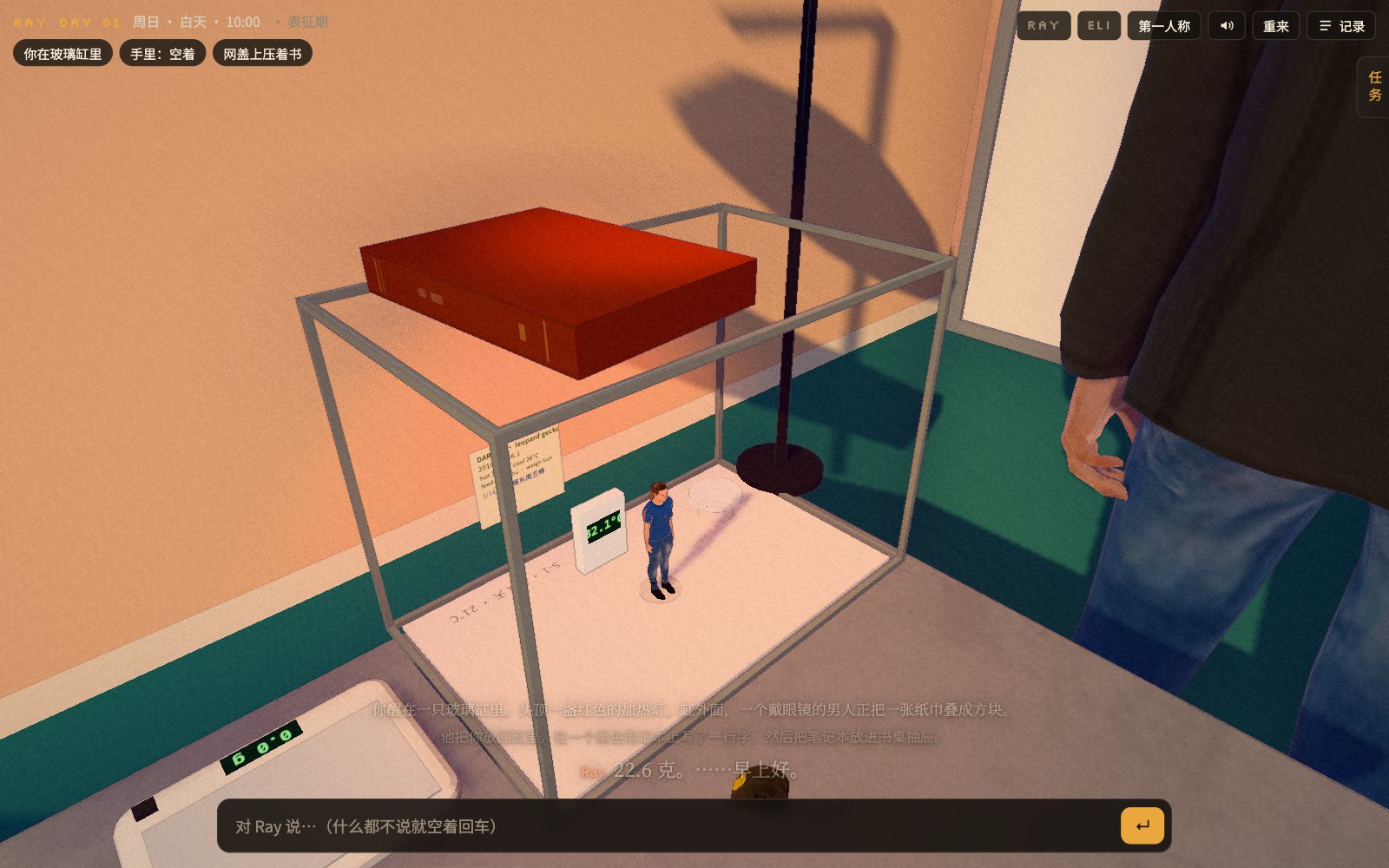
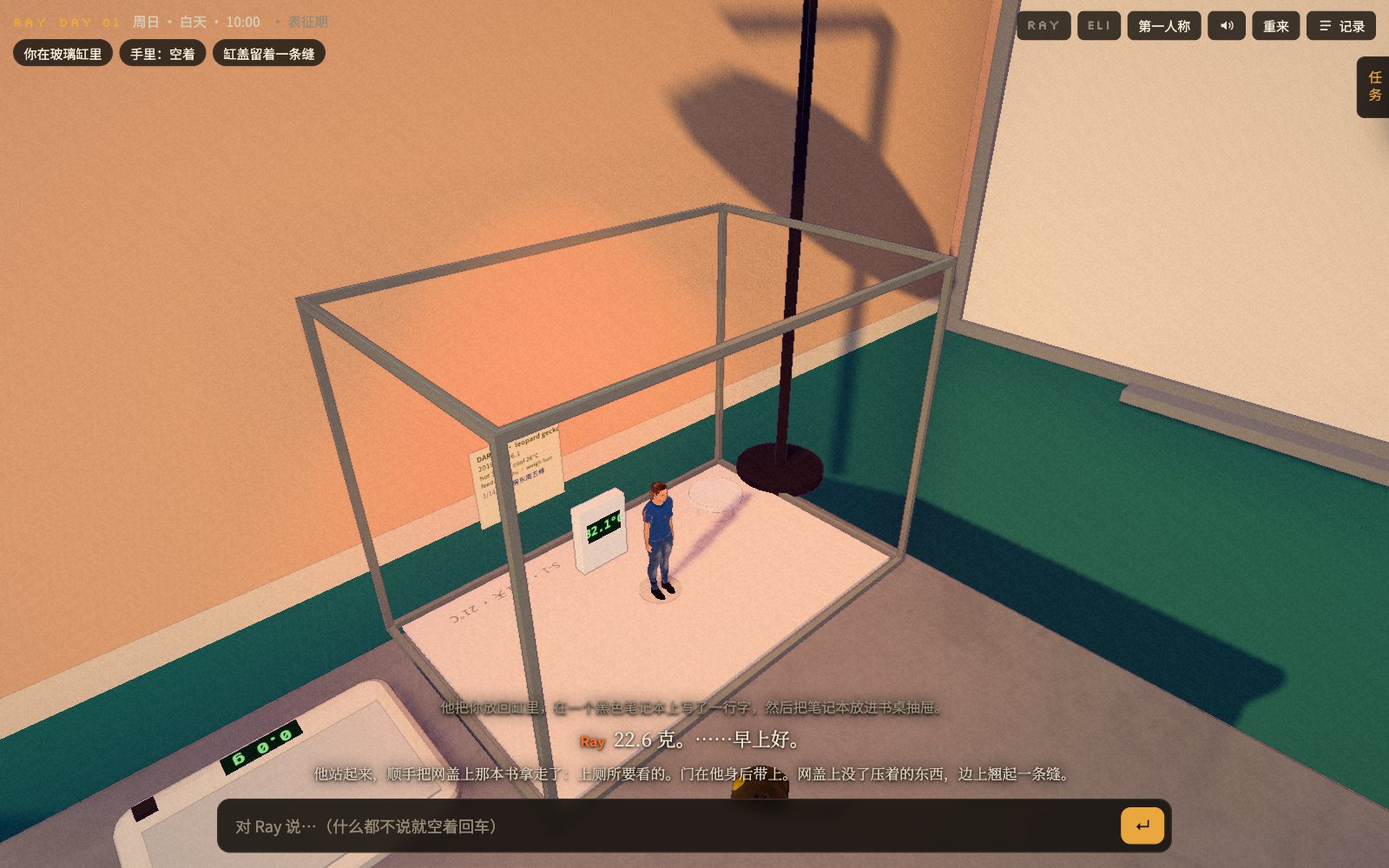
Each character runs on two models and a short memory that is rewritten every turn.
A small model, Jev from TypeSafe, reads what the player says and answers the few yes-or-no questions the story needs at that moment. Plain code tracks the facts: what the character can see, what the player has examined and what day it is. DeepSeek V4.1 Flash then plays the character.
Each turn also rewrites the character’s mood, temper, opinion of the player, memories and plans. A character can therefore stay annoyed for several turns or bring up at night something the player said in the morning.



One turn passes through a small judge model, plain code and the character model, and risky lines are checked before they appear.
When the player speaks, the roommate’s body reacts within 300 ms, before any model has answered: he looks up, stops his hand or turns half round. Jev then reads the player’s line and answers the questions the story needs. Code decides what the character may do at this moment, how he feels and how long he talks, and adds a fact card with details he must not get wrong, such as the player’s weight. DeepSeek V4.1 Flash writes his turn, which is a private thought, the line he says, a gesture, and his new mood and memories.
About three lines in ten mention a time, a number, a name or a promise. Those lines go to a second call to the same model, which checks them against the facts and the last twelve lines of the conversation, and a line that contradicts them is written again once. Each check adds about 0.7 seconds, so only these lines wait for one. If the character agrees to something the rules do not allow yet, such as taking the book off the tank’s lid before he trusts the player, he is asked once more and the claim is then cut. A turn costs about $0.0006 in model calls, so a 40-turn room costs about 2.4 cents.

Ray and Eli are MakeHuman characters moved by an animation puppet written in code.
A script builds each character in Blender with MakeHuman, including face shapes for blinking, mood and speech. The puppet handles every movement, from walking around furniture with planted feet to sitting down on a chair or bed. The roommates move at 12 frames per second and the player at full frame rate, which gives the roommates a stop-motion feel. An automated test plays every movement frame by frame and flags limbs that pass through furniture.
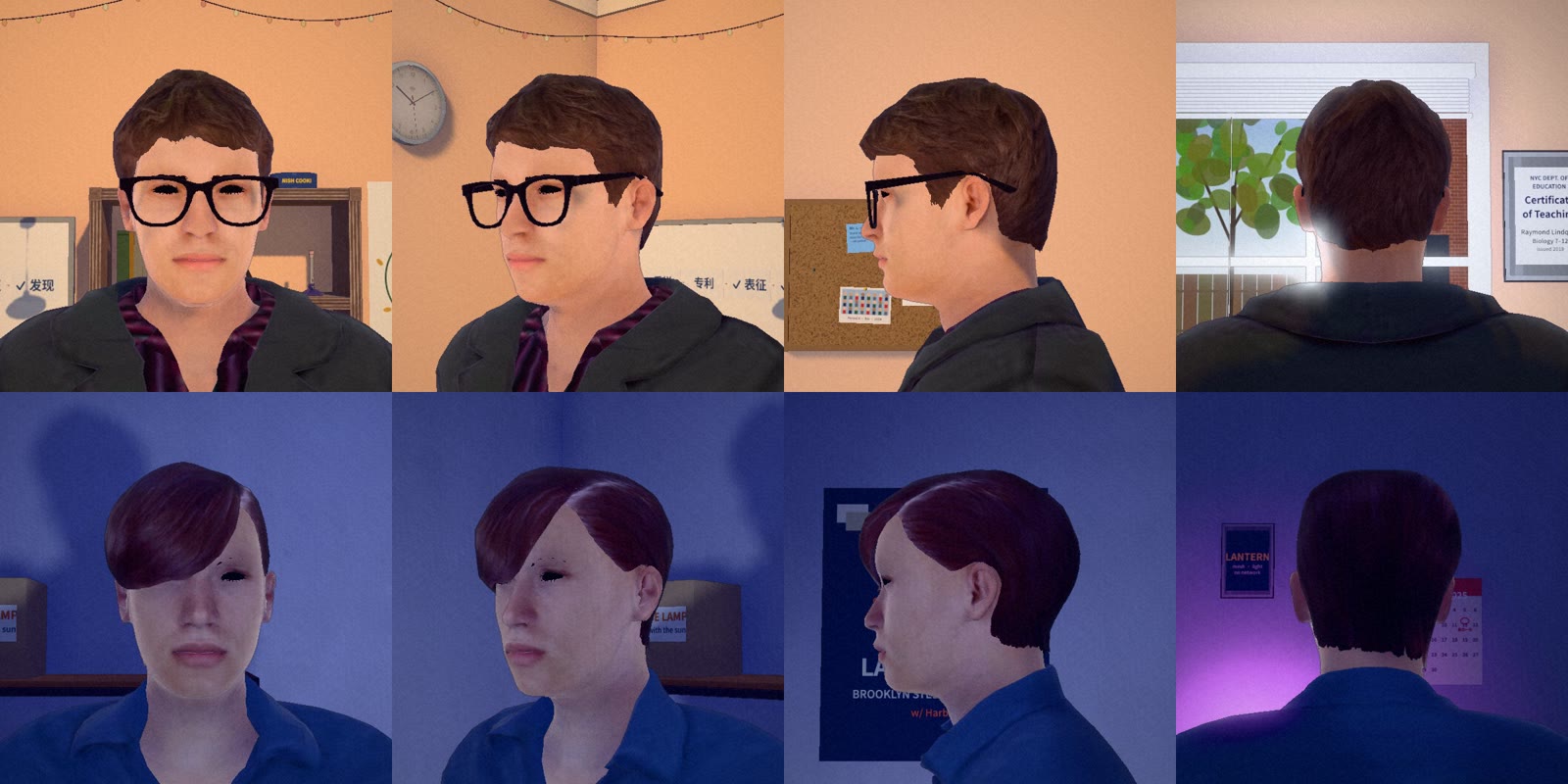
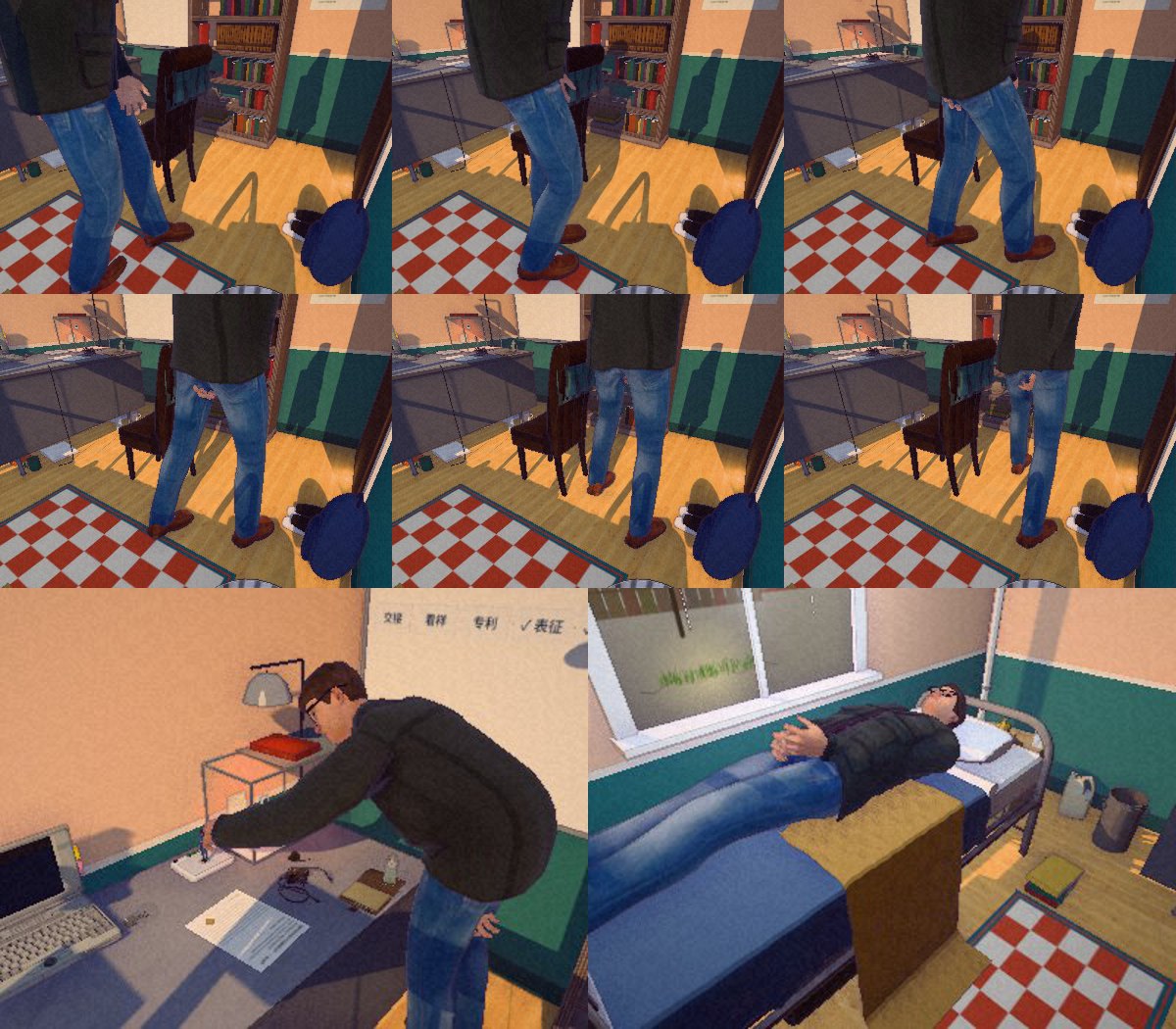
The visual style is toon shading with ink outlines, chosen after testing six styles in Blender.
Shadows are lavender by day and indigo at night, and no area goes fully black. Each room is limited to about six main colours.
The roommates still contradict facts the game has set up, and they repeat themselves in new words.
I review test conversations blind. Two AI readers mark every contradiction, invented fact, unclear line and repetition, without knowing which version of the game produced the conversation. A 34-turn conversation still has about two serious problems. Most are slips in the timeline, such as Ray saying “yesterday” on the morning he finds the player, or Eli denying a deal eight turns after making it. The meaning check sees only the last twelve lines, so older agreements escape it.
Repetition is the second problem. Ray kept asking the player to stand up straight to be measured, because his prompt quoted that line and raised it again in every negotiation. When I removed those sources, the habit disappeared and another one appeared: in one conversation he asked five times for the first line of the whiteboard to be read out. Fixing the prompt one habit at a time does not prevent the next one.
Measurement is the third. Two readers reviewing the same conversation differ by about half a problem, so a small improvement cannot be shown with a few conversations. I considered fine-tuning a model on dialogue and set it aside for now, because almost all existing lines were written by DeepSeek itself, and training on them would reinforce its own habits. The next step is a blind test in which people play Ray and Eli, to give the reviews a human baseline.
A task should always be completable, and a rule that must hold belongs in code rather than in the prompt.
Waiting for the clock was a design failure. When the room has to change before a task can be done, an event with a motive, a few seconds later, changes it, and the player never waits for a day to pass.
Eli’s prompt told the model not to talk to the player yet, and it answered the player within four turns anyway. The same rule held once it was a state in code that sends his lines to the cat.
Removing controls made the room itself the interface. The player clicks objects and talks, and the record and the hints stay hidden until the player asks for them.
